
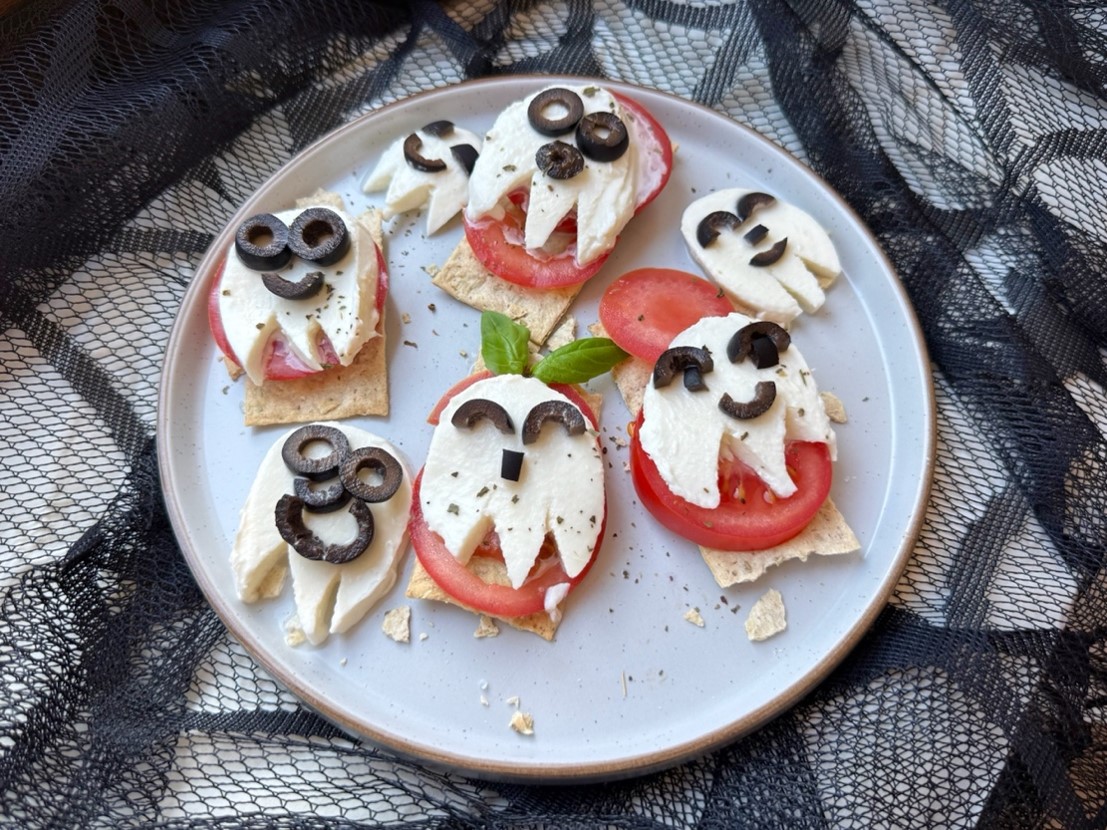
These ghosty tomato crostini are a spooky take on Italian bruschetta and crostini recipes. This recipe is made simply by using wholewheat crispbread instead of bruschetta or crostini, which also reduces the snack’s fat content. To make this snack ghostly, the mozzarella is shaped into ghosts and faces are added using black olives. These crostini are a source of calcium, which is needed for normal growth and development of bone in children.
Serves: 3
Dietary: Suitable for vegetarians, nut-free, egg-free
Contains; Gluten (crispbreads) and milk (mozzarella cheese, crispbreads)
May Contain: Sesame (sesame seeds)
Preparation time: 30 minutes
Cooking time: 0 minutes
NB: Substitutions will be made for allergens where it is known that a child has an allergy. Please make sure your Holiday club is aware of your child’s allergy in advance.
INGREDIENTS
2 tomatoes (180 g), sliced into 6
1 ball of mozzarella (125 g), sliced into 6
5 black olives (15 g), sliced
4 long crisp breads (25 g), broken in half
Optional: basil leaves for garnish.
METHOD
- On a chopping board, use a knife to shape the mozzarella slices into ghosts by cutting two triangles out of one side (see photo below for the shape).
- Use the olive slices to arrange the faces of the ghosts.
- On a plate, layer the tomato slices onto the crisp bread (one slice per crisp bread).
- Use a butter knife to gently slide under and pick up the mozzarella ghosts and layer these on top of the tomatoes.
- Optionally sprinkle some dried or fresh basil over the top.
This recipe has been donated by Jemma Higgins, Student Dietitian at University College London
NUTRITION INFORMATION
Per serving: 120g (serves 3)
Total calories: 173 kcal
Fat: 9.8 g
of which saturates: 5.9 g
Carbohydrate: 9.7 g
of which sugars: 2.3 g
Fibre: 3.4 g
Protein: 9.4 g
Salt: 0.76 g
NUTRITION FACTS
- These ghosty crostini are a source of protein. Protein contributes to the growth of muscle mass, maintenance of muscle mass, and the maintenance of normal bones.
- The mozzarella ghosts are a source of calcium, phosphorus, vitamin A, Niacin, and vitamin B12.
- Calcium contributes to normal blood clotting, energy-yielding metabolism, muscle function, neurotransmission, function of digestive enzymes, bones and teeth, has a role in the process of cell division and specialisation and is needed for growth and development of bone in children.
- Phosphorus contributes to normal energy-yielding metabolism and normal function of cell membranes. Phosphorus also contributes to the maintenance of normal bones and teeth.
- Vitamin A contributes to normal iron metabolism, maintenance of normal mucous membranes, normal skin, normal vision and function of the immune system
- Niacin contributes to normal: energy-yielding metabolism, function of the nervous system, psychological function, the maintenance of normal mucous membranes and skin, and the reduction of fatigue.
- Vitamin B12 contributes to normal: energy-yielding metabolism, functioning of the nervous system, homocysteine metabolism, psychological function, red blood cell formation, function of the immune system and the reduction of tiredness and fatigue.
VARIATIONS
- For those who do not eat dairy, olives can be used to make olive spiders instead of the mozzarella ghosts.
- Vegan cheese can be used instead of mozzarella as a dairy-free alternative.
- Gluten-free crostini can be used for those who eat a gluten-free diet or are coeliac.
Consumer Tested by Aaliyah Zubair at Birmingham City University
Checked by Susan Burry, Registered Dietitian and Sarah Foster, Registered Dietitian
© 2026 The Caroline Walker Trust